Never Lonely with Birds Around by Kate McFarland
By paying mindful attention to birds, I came to realize that I am never alone when birds are present, and in turn I was empowered to fly freely myself…
I live alone by choice. Some people say that I “enjoy my own company,” and I suppose they’re right. But that doesn’t mean I never become lonely, or that I never desire the co-presence of other living, perceiving, thinking beings.
When I was a graduate student, I engaged in the typical practice of frequenting coffee shops with a laptop in tow – less out of the need for caffeination than for the diversion from the solitude of my one-bedroom flat. I thought of myself as an urbanite in those days. I lived in the downtown metropolis for so long that I became habituated to the concrete, asphalt, skyglow, and soundtrack of traffic. I hated driving, walked or biked for all my daily errands, and kept a small radius of activity. I never ventured into the country, and I paid scant attention to birds.
…until one day when I saw a stately great blue heron at an urban park, pulled over on my bike, and gazed in awe—what a bird! That heron planted the seeds of awareness of my non-human neighbors, although their germination was slow at first.
Within one year of that watershed heron moment, I travelled abroad for the first time in my life. If that heron was my spark bird, then rural Denmark was my spark place. The countryside of North Zealand was like nothing I’d even imagined possible as an American – its compact villages, its network of bike routes, its footpaths, its easy transit connections back to the cities. It was an epiphany. Columbus never felt the same after that first flirtation with car-free, bike-based rural living.
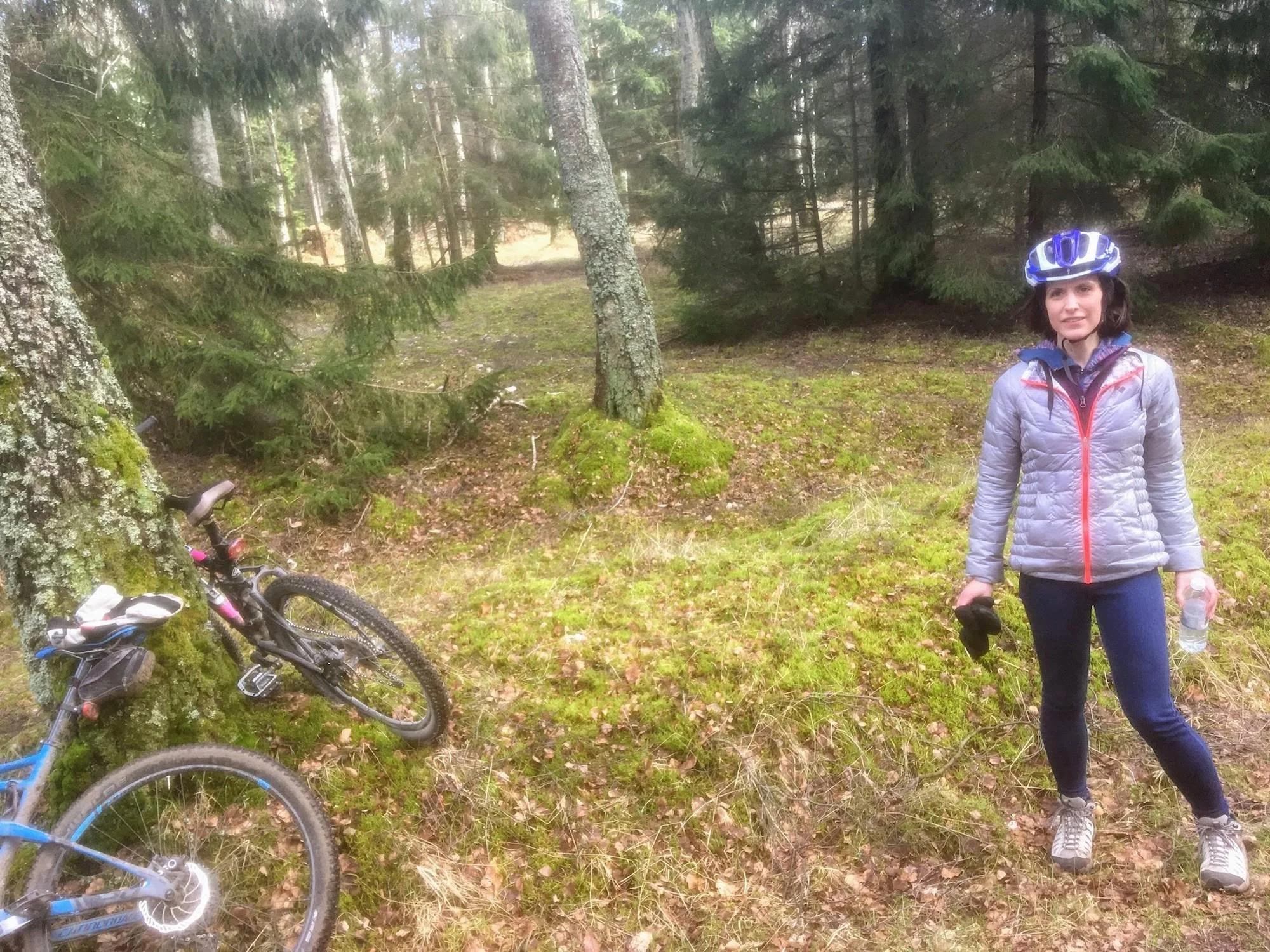
The author, Kate McFarland, in Tisvilde Hegn (Denmark)
At the end of that year, I found myself “between jobs,” and I decided to take a “gap year” (or at least a few gap months) and live abroad as a nomad. When my apartment lease reached its end date, I turned in my keys and left on a one-way ticket to Denmark. It took only a few weeks, though, for me to discover that I wasn’t psychologically prepared to live in small towns with fewer opportunities to be around people, and virtually no opportunities at all to eavesdrop on conversations in my native tongue. Within a couple of months, I had returned to Columbus to be near friends and a varied selection of coffee houses and brewpubs.
As fate would have it, though, I returned to a different neighborhood – replacing the concrete jungle of downtown with the ravines and riparian habitats of the much more residential Clintonville neighborhood. My new apartment was steps away from the banks of the Olentangy River, and it turned out that the Olentangy abounded with great blue herons. Meetings with the majestic modern dinosaurs were no longer rare one-off encounters but part of daily life.
Several herons spread themselves out along the river, and soon I began to recognize them not as mere members of a species but as distinct individuals. They had their own territories, their own daily rhythms, and even their own distinct personalities. Some were more skittish than others, some more bossy. Some predictably screamed “krrraaaacck” when disturbed; others alighted silently.
Great Blue Heron in Olentangy Watershed (Columbus Ohio) © Kate McFarland
In early spring, great egrets joined the great blues at their fishing spots – or at least they tried to. Interspecies relationships could be strained. At one dam, the great blue and the egret fished together in peace for much of the day, keeping to their personal space on their opposite halves of the river. But if the egret flew off only to return a short time later, the heron made no delay in chasing the egret away. While I must take care not to project my own personality onto their very different lives and concerns, one got the sense that the heron was relieved to finally have the river to himself after hours of quiet tolerance, only to experience this relief dashed by the egret’s return.
While watching the herons, I also began to pay closer attention to other birds in the urban riparian ecosystem. When the barn swallows returned, they mesmerized with dizzying acrobatic flights over the river. Their swirling pursuit of aerial prey seemed to complete the scene – the perfect foil to the herons’ motionless ambush hunting.
Meanwhile, other passerines weren’t so tolerant of the statuesque waders. In one particularly amusing incident, a red-winged blackbird made a dramatic entrance while a great blue stood at the water’s edge, kicking the heron square the posterior. The heron, one of the quiet individuals, was quickly off without a word. It turned out that herons were not the only territorial birds along the river, and not always the dominant one. Later, I would see red-winged blackbirds divebomb ospreys and even ride a red-tailed hawk. They joined the ever-growing list of birds I never failed to notice.
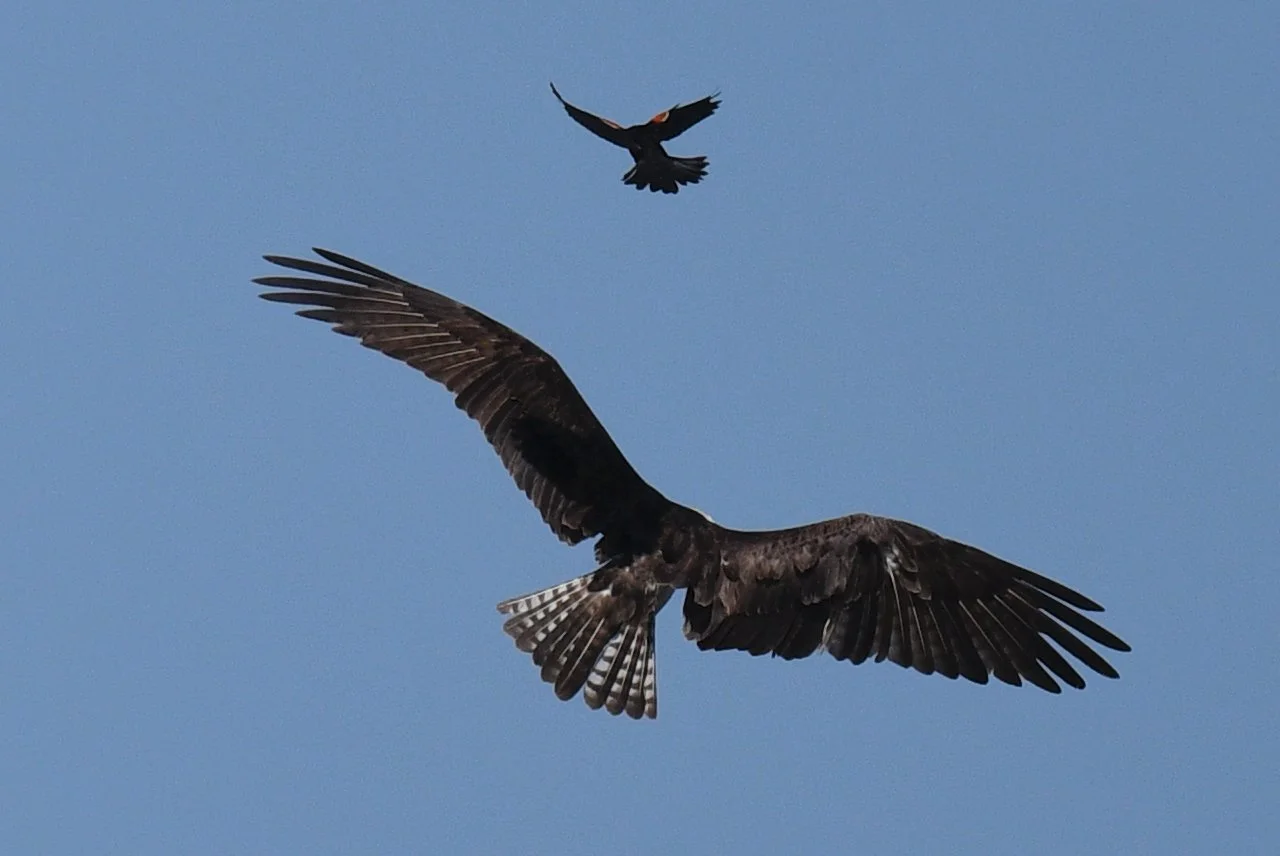
Red Winged Blackbird versus Osprey (Columbus Ohio) © Kate McFarland
By the start of May, the riverside trails also teemed with binocular-clad humans. In the beginning, I could only nod and act interested as they said things like, “Mostly just butter butts, but we had one Blackburnian and a black-throated green.” I didn’t have my own binoculars then, and at first I was hopeless to spot these warblers that elicited such excitement. Then one day I was walking through one of the hidden footpaths, and out of the scourge of honeysuckle hopped a tiny, bright yellow bird with an olive-green back and a sunny face encircled in black. A hooded warbler. I understood the craze from that moment on, and I finally ordered some binoculars.
I could go on about the thrill and excitement of that formative year, but the takeaway was this: I learned to see birds as company, and there was no going back.
I never became a lister. I never took to birding as sport. Yet, wherever I went, I couldn’t turn off the instinct to notice birds around me. And whenever I watched them, it was impossible to deny that these newfound feathered friends were fellow living, perceiving, thinking beings. It was exactly that sense of fellow feeling that prompted me to tell a friend, “I could never feel lonely here with so many birds around.”

Cedar Waxwing outside of the authors former apartment in Clintonville (Columbus Ohio) © Kate McFarland
That formative year, by the way, was 2019…
Despite my claim that birds were a prophylactic for loneliness, I did not feel mentally ready when the first lockdown was announced. Throughout my months of wandering along the banks of the Olentangy, I never fully broke my habit of taking my laptop to work at coffee shops or the occasional brewpub. I had also begun sitting in on classes at the university several days per week, and I even took a job teaching one.
The first lockdown was only two weeks, yet I still had a moment of panic. I wasn’t sure how I could cope. In that instant, I failed to trust the birds – and yet, in the end, the birds came through. As the pandemic dragged on, and two weeks turned into two months and counting, I never got lonely with so many birds around.
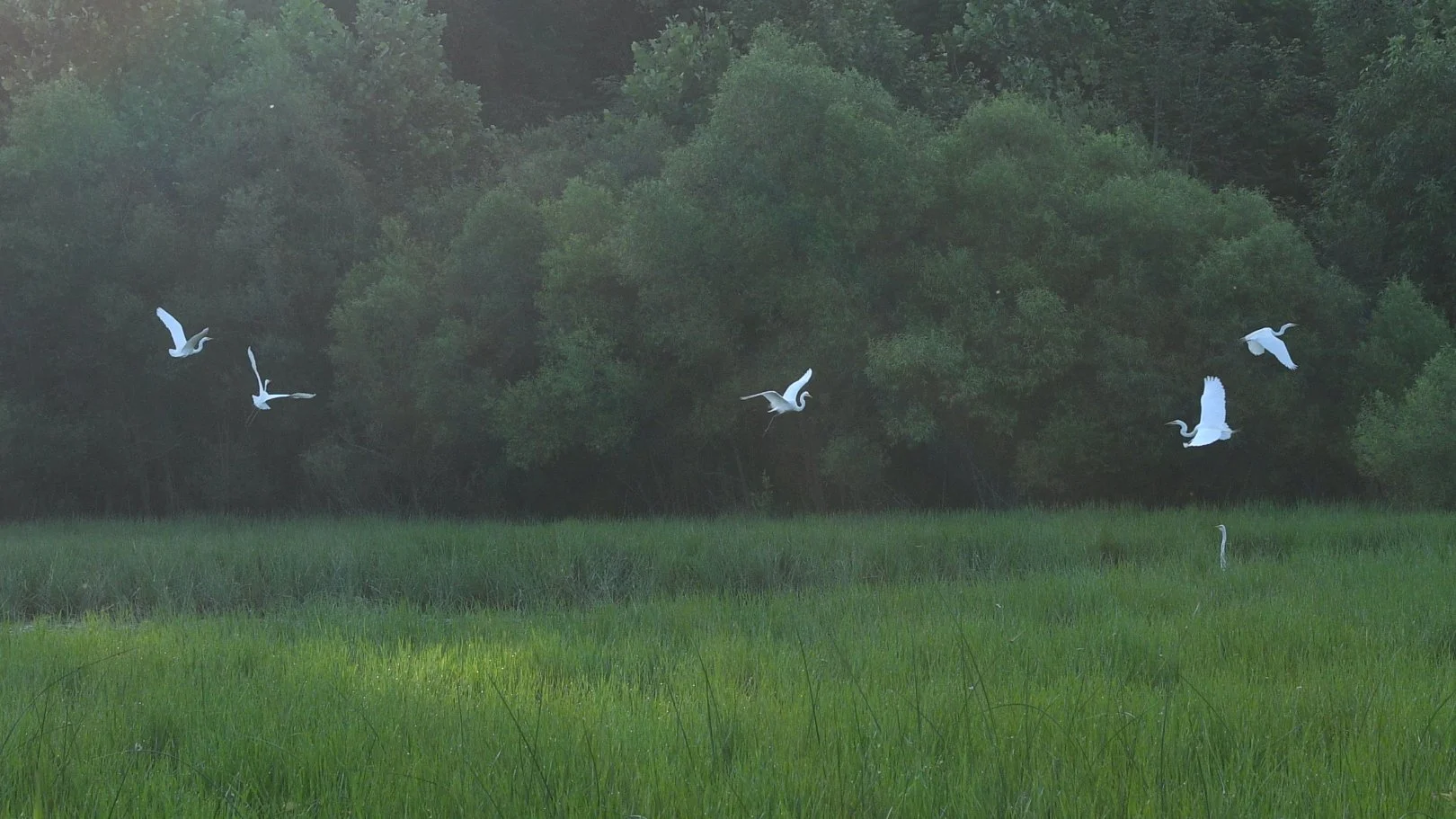
Great Egrets in Olentangy Wetland Research Park (Columbus Ohio) © Kate McFarland
Thanks to the presence of birds, enduring the lockdown was surprisingly easy, and my mind wandered back to those places I loved across the sea – the bike rides under the Milky Way, the sleepy villages with nothing but the sound of the sea and the nightingale. I missed it.
After more than two years without travelling outside of central Ohio, I made my decision: As soon as Europe reopened its borders in mid-2021, I would once again turn in my keys and leave on a one-way ticket, an open-ended trip. Loneliness had truncated my earlier experiment, but after a year and a half of Covid, birds had given me confidence that I was prepared to cope with any amount of social isolation.
My first destination was the historic town of Stege on the Danish island of Møn, and I arrived to meet a stately grey heron in the harbor. It felt like a homecoming – with a new friend to greet me.
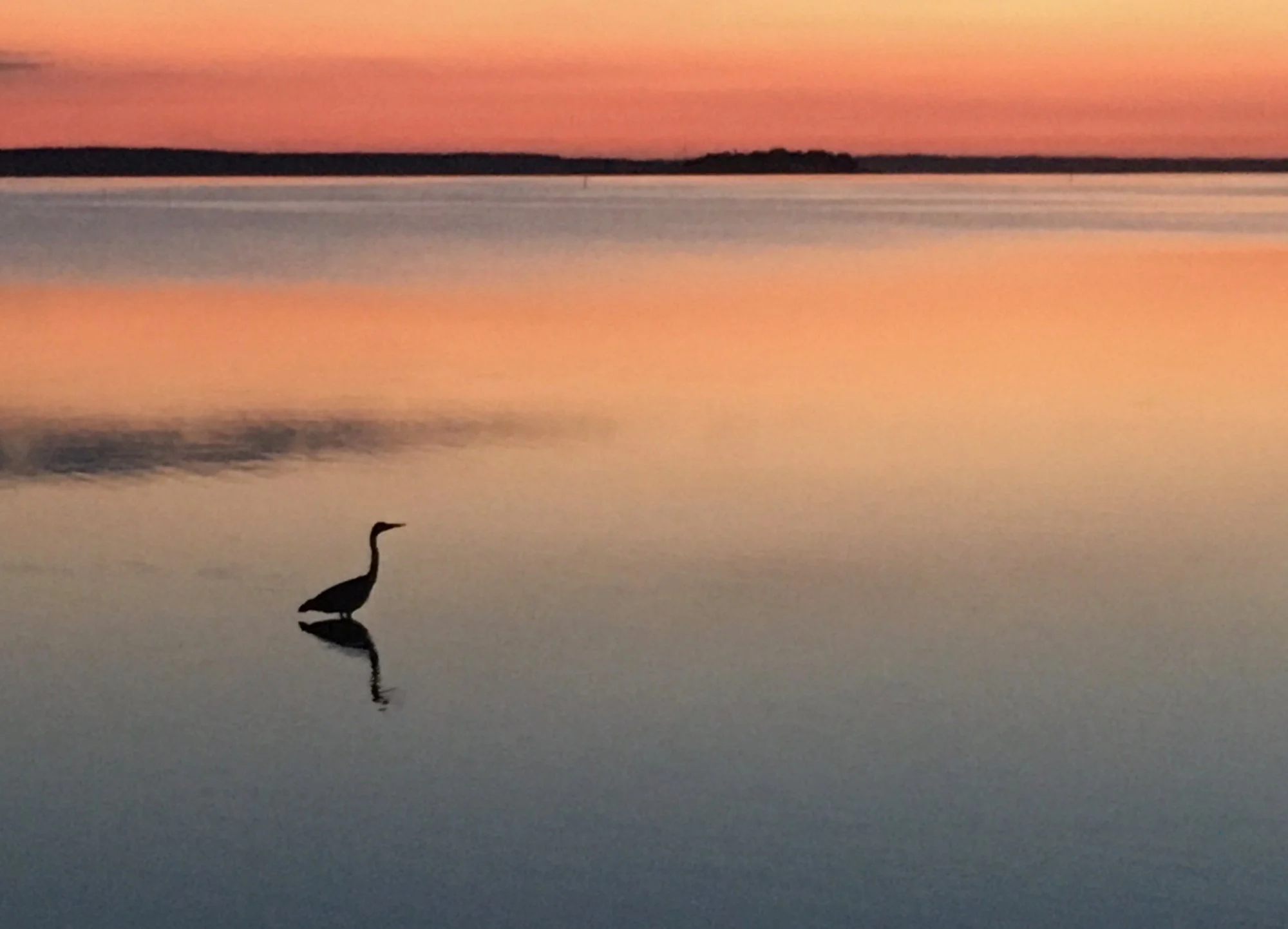
Grey Heron (Fiskehejre) in Stege Harbour (Denmark) © Kate McFarland
When I travel now, loneliness is never the limiting factor. Having learned to notice and appreciate the co-presence of birds, I can now enjoy extended “staycations” in remote places that would have been too psychologically grueling in the past.
During subsequent travels, one of my favorite discoveries was Anholt, Denmark’s most remote island. Outside of the tourist season, nearly every business closes on this tiny island of around 130 residents (save for one surprisingly well-stocked grocery store). I find it incredibly blissful in the calm and silence of winter – yet it does feel a bit like reliving the lockdown experience, where outdoor walks and bike rides are still permitted (as was the case in Ohio) but the only business you can set foot inside is the local grocery store. It might have found it agonizingly lonely if I had not been disposed to closely observe the numerous feathered friends who frequented the garden – from the solsort (blackbird), dompap (bullfinch) and bogfinke (chaffinch) to the occasional kvækerfinke (brambling).

Resident Blackbird (Solsort) at Airbnb on Anholt (Denmark) © Kate McFarland
Another year, I ventured to the tiny car-free Croatian islands of Silba and Olib in the late autumn. The beaches remained beautiful with the clear blue waters of the Adriatic, but deserted, the handful of restaurants locked up until the next season. I remember Silba in particular for an incredible fallout of the most tame and endearing goldcrests I’ve ever met – once again, saved from loneliness by the birds.
On occasions like those, I intentionally visited small islands at times of the year when virtually nothing is open. On other occasions, I’ve found that the pubs in small and remote villages don’t always provide the most agreeable setting for a quiet female solo traveller who’d rather not become the center of attention in a male-dominated crowd. Fortunately, everywhere I’ve been there’ve also been birds – some of them solitary too, some of them temporary sojourners like me – and the birds and I seem to reach a mutual understanding that while we notice one another, we will let one another be.
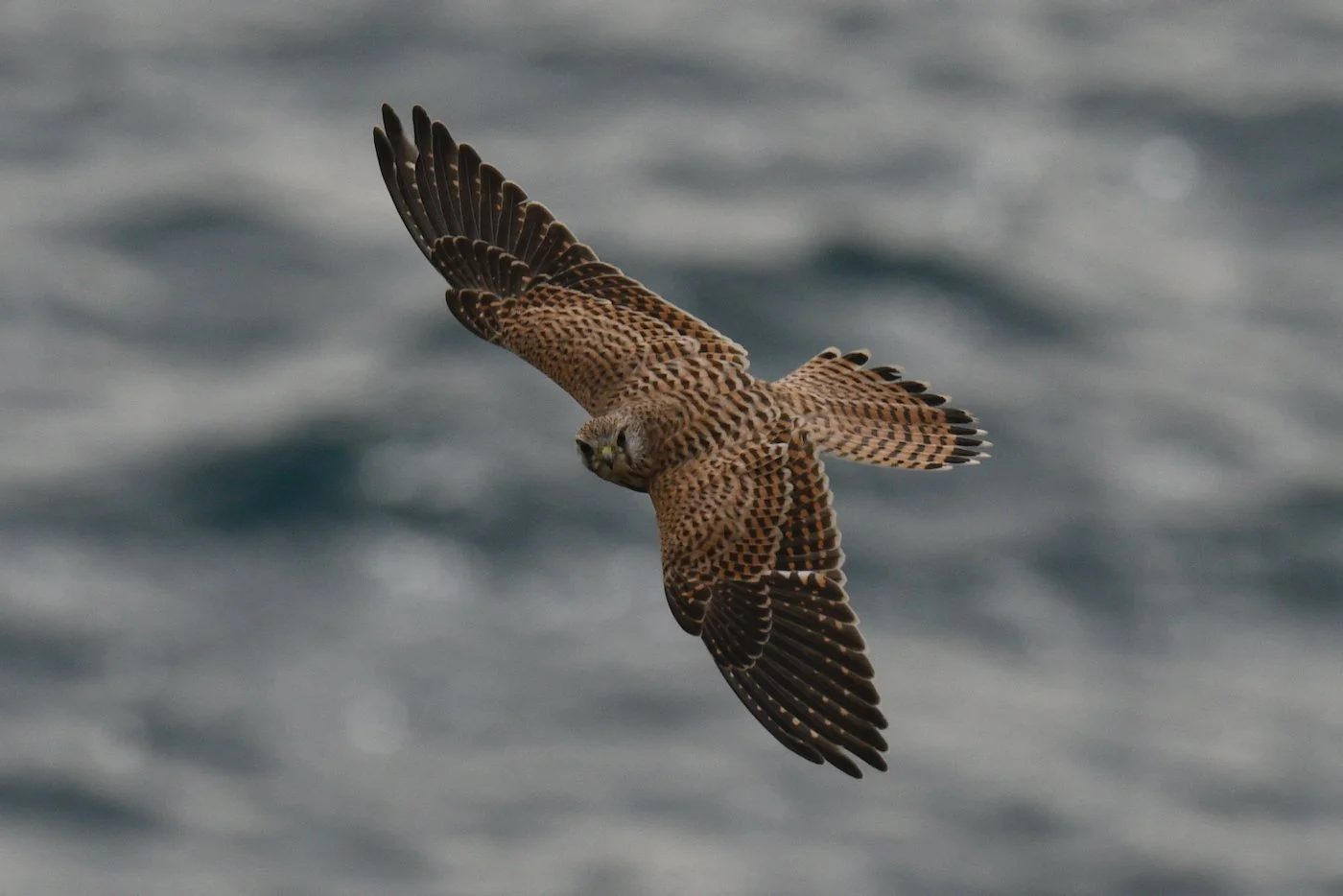
Kestrel flying near Herm (Channel Islands) © Kate McFarland
Birds taught me that I can happily live as a hermit, yet birds can lead back to people too. It’s an easy icebreaker to ask what birds a fellow human is seeing when they’re sitting in a bird hide with binoculars, and pointing at an ID guide is a universal language. Earlier this year, I was invited to write a guest blog for the Dutch research and creative center BirdEyes, in which I remarked that the shorebirds of the Wadden Sea led me to the annual conference of the International Wader Study Group. It was true. I’m not a researcher. I’m not a graduate student with advisors encouraging me to present a paper. I had no professional connections. I found out about the event only due to my affinity for birds I’d met when my travels coincided with theirs.
Inevitably, these experiences have left me with a strong desire to give back to birds, and my perception of birds as company has indelibly changed the way that I think about conservation. Just as birding is not merely about adding another species to one’s life list, conservation is not just about saving species; it’s also about making the world better for so many fascinating, charming, and intelligent individual beings with whom we share it.